
Startup-Booted Fundraising Strategy: A Guide for Founders

Authored by
Varun
Date Released
06 Oct, 2026
Bootstrapping a startup helps the founders prove their demand, perfect the business model, and gain traction without necessarily giving up any control over their venture. However, once the need for capital surpasses what the venture itself generates internally, fundraising turns into an operational challenge. For bootstrapped founders, a good startup-booted fundraising strategy enables them to bridge the gap between three aspects: the current status of the business, demand for its next stage of development, and how well its financials, projections, and investor materials support that plan.
For bootstrapped founders, the goal is not just to raise money, but to approach investors with a credible plan for how the funds will be used and which milestones they will help reach.
What Is a Startup-Booted Fundraising Strategy?
A startup-booted fundraising strategy (also called a bootstrapped fundraising strategy) is the plan a bootstrapped company follows to raise outside capital after funding its early growth through founder capital, operating cash flow, or other limited resources.
Bootstrapped growth vs. raising capital: what changes
In bootstrapping, a company has the ability to operate within the capital that is either internally generated or self-funded. Raising external capital brings new parties, formal reporting obligations, due diligence, and increased scrutiny of the firm's assumptions.
Founders also have to tell what the company has accomplished so far and what more it will be able to accomplish thanks to new funds raised.
Why founders wait to raise until after growing lean
Some of the factors, like revenue history, customer retention rate, and operational data are important to show investors the business and help the founders to build traction before fundraising.
It doesn't mean that postponing fundraising is always the best decision. In fact, the best timing depends on certain elements like the company's growth prospects, cash position, capital needs, and desired goals.
Table of Contents
Startup-Booted Investor Readiness: Are You Ready to Raise?
Startup-booted investor readiness is not about producing one single revenue figure; instead, it's all about the ability of the company to back up its fundraising case with facts.
Investors usually want to know more about some basic things like traction, business model, use of funds, growth projections, financials, and risks.
Revenue, retention, and traction signals investors review
Depending on the business model, investors may examine:
The relevant set of indicators may be different for every company; hence, founders need to concentrate on the indicators that show how their business evolves.
Questions to ask yourself before approaching investors
Founders should be ready to answer the following questions before reaching out to potential investors:
If the answers to these questions are not clear within the company itself, they are going to become even harder to give when the investor analyzes the information.
Common readiness gaps founders overlook
Typical readiness gaps include inconsistent historical indicators, mismatch between the pitch deck and financial model, unclear use of funds, low-quality financial reporting, and fuzzy growth assumptions.
In this regard, fundraising planning must begin with linking up all these elements prior to any actual investor interactions.
Understanding Different Types of Fundraising
Capital structure requirements may be different from one business organization to another. Issues related to capital structure choice include risks, cash flow, and stockholders' preferences.
Equity vs. debt vs. convertible instruments
The process of getting the money through ownership is known as equity financing, which does not require any repayment plan but results in dilution of ownership.
When using debt financing, founders can keep their ownership, but there will be repayments, interest, and certain conditions.
Convertible instruments are financial instruments that are capable of converting to equity in the future under specified terms.
Hence, founders need to consider the structure properly, discussing the issue with suitable financial and legal advisers, since sometimes there is a difference between economic and legal implications.
Angels, VCs and strategic investors
Angels usually tend to invest in an earlier stage and provide operating or industry experience.
VCs are inclined to invest based on certain criteria like stages, sectors, growth, and return.
Strategic investors invest for commercial and financial purposes both.
Therefore, it would be more reasonable to ask "What type of investor suits the firm's needs and stage?" instead of "Who will invest?"
Priced rounds vs. SAFE agreements
A priced round means the startup and the investor agree on valuation and issuance of equity within defined parameters.
SAFE investment allows the investor's money to be converted into equity at a future date rather than agreeing upon the entire equity structure in one go.
Thus, it is important for founders to know about their rights, dilution, etc. before proceeding further with the instrument.
Building the Financial Model Investors Will Test
Startup-booted financial modeling turns the fundraising story into numbers.
The pitch deck may tell a company's vision. The financial model must lay out what needs to happen from an operational perspective in order for that vision to seem realistic.
Three-statement models and forecasts
For companies where the level of detail is warranted, an integrated approach can connect:
income statement → balance sheet → cash flow statement
and forecast the above three statements.
Thus, ideally, the financial model would reflect the actual drivers of the business rather than just comparing a growth rate against historical sales. In any case, revenue forecasts, cost structure, working capital management, capital expenditure, financing, and cash flows should all connect logically.
Scenario planning and assumptions investors will challenge
A forecast on its own is not usually sufficient.
Entrepreneurs need to know what occurs when:
This can be achieved by preparing different scenarios, such as a base, worst-case, and best-case scenario.
Common financial modeling mistakes
Some of these common errors include a disconnect between the forecast and previous performance, assumptions built into the formula, growth in revenue without corresponding operating cost growth, improper handling of cash flow, and inconsistent data between the model and the pitch deck.
A model should allow you to test the assumptions easily rather than hiding them.
Startup-Booted Valuation: How Investors May Approach Value
A startup-booted valuation is not measured by revenue alone. Capital required, market opportunity, growth stage, margins, recurring revenue, customer orientation, risk, competition, and financing environment all play their roles in valuing a company.
How lean growth history affects valuation
A lean growth history indicates that the company has managed to generate some traction working within resource constraints.
Investors will look at what the company has achieved: revenue quality, retention, margins, operating discipline, and repeatability, and how much the external investment will accelerate the process.
Common valuation methods used at this stage
Some of the methods which may be used in valuing a firm at this stage include the use of comparable firms or transactions, DCF model, revenues or earnings multiple, or venture stage models where there is consideration of future results and returns for the investors.
All the above methods may not necessarily apply to all startup firms.
Why revenue alone doesn't determine valuation
Not every firm with similar revenue will have similar economics.
In addition, a company that generates recurring revenues will have a different risk profile from those that have volatile revenues because of the existence of good margins, strong retention, and diversified customers.
Revenue only provides context; it does not capture the whole picture when it comes to valuing a company.
Building the Startup-Booted Pitch Deck
The creation of a great startup-booted pitch deck will help a firm articulate its story well to the investor regarding financing and economics. The deck and financial model should support each other instead of telling different stories.
What a strong pitch deck needs to cover
While the exact structure varies, most fundraising decks need to explain the:
The most valuable deck is not necessarily the deck with the most prevalent slides, but the deck that allows the investment case to be much clearer.
Teasers vs. full decks: when to use each
A short presentation aimed at attracting investors' attention to a deal while not providing too many details is known as a teaser.
A full pitch deck presents investors with an overview in order to provide them with enough information about the company, its progress, its team, financials, and fundraising plans.
Which material to share first depends on the fundraising process and the investor relationship.
Data room preparation for due diligence
Once the investors' interest is expressed seriously, there may be a need to provide some backing for the pitch through additional information.
An ideal data room includes, but is not limited to, financial statements, forecasting, tax information, capital structure information, contracts, client information, corporate information, intellectual property information, etc.
The Fundraising Process, Start to Finish
A well-developed fundraising strategy works much more efficiently if it is implemented as a process rather than a sporadic investor contact.
Building the investor pipeline and beginning outreach
Firstly, identify investors who have a similar position, industry, size, and investment philosophy to match those of the company.
Secondly, ensure proper documentation of introductions, meetings, communications, follow-up activities, information requests, and future steps.
It is also advisable to use a focused investor pipeline rather than broadcasting to all possible investors.
Preparing for investor due diligence
Investors will verify the claims made during fundraising against the underlying financial data and documentation. Additionally, investors can examine financial performance, capital structure, forecasts, customer metrics, agreements, market assumptions, business risks, and legal issues.
Accordingly, the model, deck, and the underlying data should be aligned.
Move from term sheets to closing
A term sheet usually describes key economic and governance provisions prior to finalizing the transaction documents.
In a startup-booted fundraising process, the founder of the firm must verify certain things with appropriate advisers prior to the closing of the term sheet, for example, investor rights, valuation, dilution, board provisions, liquidation, and other relevant aspects.
How Much Capital to Raise and When
There is no set amount that every startup should be raising.
A startup-booted fundraising strategy should connect the firm's expected cash needs and milestones with the time required to reach the next significant stage.
Match the raise to runway and milestones
Define what the business wants to do, not what the target funding amount is.
For instance, the capital will be used for expansion, service improvement, geographical extension, targeted capacity, infrastructure, or other types of growth initiatives.
Then calculate the necessary resources to achieve these milestones with an appropriate buffer.
Calculate a realistic burn rate
Burn rate defines how fast the company is burning cash in a certain period. So the founders should focus not only on current expenses but also on the inflow/outflow of funds.
As a result, the forecast will represent how the various operating scenarios influence the runway.
Startup Financial Planning & Growth Insights
1
How Financial Modeling Helps Startups Grow Smarter
›
2
How FP&A Drives Better Financial Decisions
›
3
Why Capital Budgeting Matters for Growing Businesses
›
4
How Corporate Finance Supports Sustainable Growth
›
5
What a Fractional CFO Really Does for Small Businesses
›
6
How Ratio Analysis Reveals Business Performance
›
7
How Variance Analysis Improves Financial Planning
›
Common Mistakes in a Startup-Booted Fundraising Strategy
Mistakes in capital planning and lack of consistency in numbers can complicate the fundraising process for even great businesses.
Weak or inconsistent financial models
Inconsistencies between the deck and the model will undermine investor confidence. Data recorded, forecasted, assumed, and use-of-funds calculations should align in the fundraising materials.
Raising without a clear use of funds
"We need capital to grow" is not good enough.
Founders must explain how the money is planned to be used and what milestones are supposed to be accomplished.
The funding raise should come from the operating plan and not be selected first and then justified.
Giving up economics or control without understanding the terms
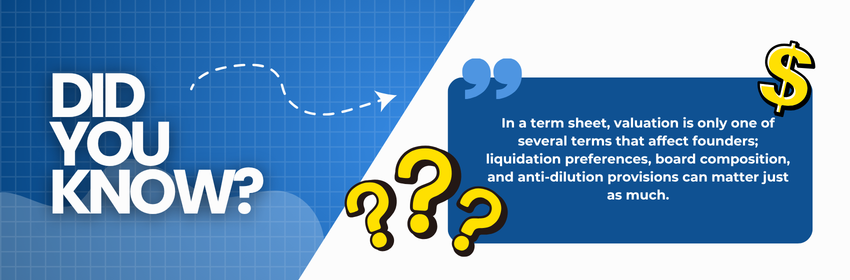
In funding rounds, headline valuation is only one part, while dilution, governance rights, liquidation terms, and financing implications are among many other issues that affect founders and their current stakeholders.
Knowing the entire structure is crucial before accepting any terms.
Where TAG Fits: Financial Modeling and Fundraising Materials
The fundraising process entails creating a big execution workload below the surface of decision-making: financial modeling, forecasting, valuations, pitch materials, and due diligence preparations are all included.
TAG's Investment & Transaction Advisory team builds the execution layer beneath the fundraising process — from financial models and valuations to pitch materials and diligence preparation.
Building the model and materials beneath your judgment
TAG supports the execution layer behind the fundraising process, while the founder and their advisers retain the strategic decisions, investor relationships, and judgment.
This follows TAG's broader positioning as an already-built finance function, not a replacement for the practitioner or the decision-maker.
Test the fit before committing
Founders and advisers do not have to introduce a new team through a live fundraising process first. A prospect can send a model or pitch deck they have already completed, and TAG redoes it so they can compare quality, communication, and formatting without putting live work at stake.
Conclusion
A strong startup-booted fundraising strategy is built well before the first investor meeting. It brings together verified financials, a business story that matches the numbers, a clear use of funds, scenario analysis, consistent investor materials, and a prepared due diligence process.
Ready to turn your fundraising strategy into investor-ready financials? Send TAG a model or pitch deck you've already built. We'll redo it so you can compare the results before committing to anything.
Related Blogs



Common
Questions
Your Guide to Startup Fundraising...
It is a fundraising roadmap for an enterprise that bootstrapped itself in developing its venture and is considering other funding alternatives.
A startup is typically ready to raise capital when it has credible financial data, some operating history or traction, a clear need for the funds, well-supported projections, and a solid plan for using the money.
There is no universal formula for that. Among the things that are assessed by investors are historical growth, quality of revenues, profit margins, customer loyalty, market size, risks and competition, prospects, and conditions of the proposed financing.
It depends on the company, but in general an investor expects the model that provides information on past and future performance and operations of the firm, including cash flow data and possible scenarios of alternative outcomes to understand the impact of changing assumptions on operations of the firm.
One starts by establishing the goals of the firm, finding out how much capital will be required to achieve them, establishing the expected burn rate and runway, then justifying the required capital.
A teaser is a marketing document designed to capture the attention of investors. The pitch deck, on the other hand, contains more detailed information about the firm, such as the target market, traction, business model, management, projections, and funding.