
Accounting Outsourcing Due Diligence Checklist for CPAs

Authored by
Varun
Date Released
11 Aug, 2026
Quality, security, and accountability are not just two key factors CPA firms should evaluate before finalizing an outsourcing partner; instead, they should know exactly who will handle their client work, how data will be protected, and what protocols will be followed if something goes wrong. With a well-prepared accounting outsourcing due diligence checklist, you can review team structure, confidentiality, SOPs, system access, and trial processes before signing a contract. TAG simplifies this process with client-controlled security protocols, NDA-backed onboarding, full-time employees, and a low-risk trial on work you have already delivered.
What Is Accounting Outsourcing Due Diligence?
Accounting outsourcing due diligence is an important step in validating the service provider's track record before handing over financial workflows, tax documents, or client books. A practical accounting outsourcing due diligence checklist comprises work standards, compliance, technical competencies, security control measures, employee screening, and accountability.
So, in short, if you want to know what outsourcing due diligence is? It is the homework a CPA firm does before trusting an outside team with sensitive client work.
Table of Contents
Why due diligence matters before offshoring accounting work
The key reason why due diligence matters before outsourcing accounting work is that the CPA firm still carries responsibility for the final client service, even when part of the work happens offshore.
Before signing, firms should check the provider's accounting experience, review sample work, understand quality controls, assess IT safeguards and incident-response plans, and, ideally, review relevant SOC reports. Otherwise, offshore accounting risk can show up as missed deadlines, weak workpapers, privacy issues, or simply more review work for your own team — which defeats the purpose of outsourcing in the first place.
Current adoption trends among CPA firms
The CPA firms' outsourcing statistics show that outsourcing is already fairly mainstream. According to the Journal of Accountancy's reporting on AICPA's 2023 National MAP Survey, which included more than 1,100 firms, about 30% reported domestic outsourcing and 25% used offshore workers; another 12% planned to begin offshoring. These figures reflect the 2023 survey specifically; AICPA has since released its 2025 National MAP Survey.
Broader accounting outsourcing adoption is moving in the same way. Mordor Intelligence's Finance and Accounting Outsourcing Market report, updated in January 2026, estimates the market at $59.05 billion in 2026, with offshore delivery accounting for 56.53% of the market in 2025. Access to highly qualified international teams, talent shortfalls, automation, and cloud systems are all keeping that transition progressing.
The 10-Point Due Diligence Checklist
A verified AICPA due diligence checklist ensures that CPA firms investigate beyond pricing. Rather, they focus more on verifying whether a provider can actually protect client data, deliver consistently, and support compliance. The following accounting outsourcing checklist points combine AcoBloom's breakdown with guidance from the Journal of Accountancy and current CPA outsourcing security practices.
1. Legal & regulatory compliance verification
Start vendor legal compliance accounting checks with business registration, licenses, regulatory history, and relevant certifications. Strong regulatory compliance outsourcing should be backed by documents, not simply verbal assurance.
2. Financial stability assessment
A vendor financial stability check should review roughly three years of financial statements, cash flow, profitability, and solvency. Weakening revenue or repeated losses can signal problems with an outsourcing partner's financial health.
3. Infrastructure & technology evaluation
Review the provider's technology infrastructure outsourcing setup, including licensed software, secure systems, backups, disaster recovery, and access controls. An accounting software compatibility check also avoids workflow headaches later.
4. Data protection & client confidentiality (IRC 7216)
For data protection accounting outsourcing, check encryption, MFA, controlled access, confidentiality policies, and secure file transfer. Your IRC 7216 compliance checklist should also address policies governing U.S. tax-return information.
5. Quality assurance & internal process review
Good quality assurance outsourcing accounting includes review checkpoints, standardized workflows, error tracking, and escalation. Ask to see sample deliverables so the QA process the vendor follows is visible before live work begins.
6. Workforce expertise & staff qualifications
Check workforce expertise through resumes, professional credentials, U.S. accounting experience, training, and staff retention. Strong staff qualifications and accounting vendor evidence show who will actually handle and review your work.
7. Client references & case studies
Ask for client references from outsourcing vendors with relationships similar to your CPA firm, then speak with them directly. Relevant case studies and accounting partner evidence can reveal consistency, responsiveness, scalability, and real delivery quality.
8. SLA & contractual terms review
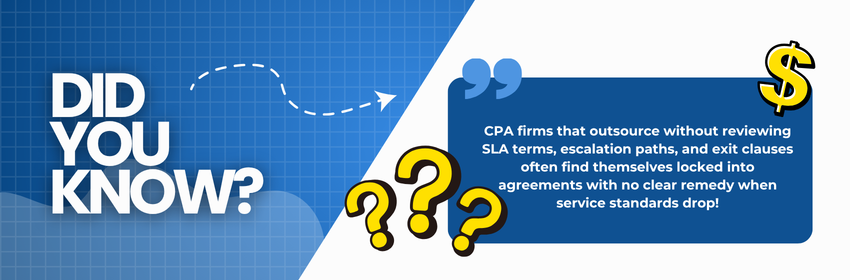
A clear SLA accounting outsourcing agreement should define scope, turnaround, performance standards, escalation, and reporting. Additionally, during the contractual terms due diligence review, the conditions related to confidentiality, termination, IP ownership, and dispute resolution.
9. Security assessments & third-party audits
For SOC 2 due diligence, request recent independent reports rather than accepting security claims at face value. An ISO 27001 accounting outsourcing audit or equivalent evidence should also be checked for scope and validity.
10. Insurance coverage verification
Verify insurance coverage in the outsourcing vendor documentation, especially E&O and cyber liability. Appropriate professional liability insurance and accounting coverage can reduce exposure when errors, breaches, or service failures occur.
Checklist quick-reference table
| Checklist Category | What Your CPA Firm Should Request | Warning Sign |
|---|---|---|
| Legal & Regulatory Documents | Licenses, compliance history, and registration | Unresolved regulatory or legal issues |
| Financial Stability | Recently audited/certified financial statements | Declining revenue, losses, or weak cash flow |
| Infrastructure & Technology | Software list, disaster recovery plan, and security controls | Outdated systems or an unclear recovery process |
| Data Protection / IRC 7216 | Security policies, access controls, and tax-data procedures | No documented confidentiality or 7216 process |
| Quality Assurance | QA workflow, review checkpoints, sample outputs | No measurable review or escalation process |
| Workforce | Staff credentials, experience, turnover information | High turnover or little team visibility |
| References | Relevant CPA references and case studies | No comparable client evidence |
| SLA & Contract | Scope, KPIs, escalation, exit, and IP clauses | Uncertain deliverables or restrictive exit terms |
| Security Audits | SOC 2 / ISO 27001 reports or equivalent evidence | Claims made without independent documentation |
| Insurance | E&O and cyber liability COIs | Missing, expired, or inadequate coverage |
Common Data Points to Prepare Before Evaluating Vendors
Always, before comparing any service provider, ensure that you have a clear accounting outsourcing scope definition. This will help you to know and highlight what types of activities are being performed outside, what data the vendor will access, and how good performance will be measured.
Hence, conducting a workflow audit before outsourcing exposes roadblocks, clearance gaps, and manual steps before they are simply transferred to someone else.
Define processes to be outsourced
Start by listing specific accounting processes to outsource — rather than a vague instruction like "handle our accounting." Bookkeeping can include general ledger maintenance and reconciliations, whereas tax support, AP/AR, payroll, and reporting each can have separate workflows.
A clearly defined outsourcing scope should also document transaction volumes, software usage, approval points, deadlines, frequency, and what remains with the CPA firm. That makes vendor comparisons much cleaner and prevents scope creep later.
Map data sensitivity (PII, bank data, tax IDs)
After that, understand exactly which information actually passes through each workflow. Data sensitivity in outsourcing accounting becomes especially important in case vendors access bank account details, payroll records, Social Security numbers, government IDs, or other financial information.
Government-issued identification and bank account numbers are categorized by IBM as sensitive PII that requires stronger security controls. Access controls, encryption, and permissions can accurately represent the actual risk through good client data classification, separating highly sensitive records from lower-risk information.
Set success targets (accuracy, turnaround time, first-pass yield)
At last, define outsourcing success metrics before the work starts, not after something goes wrong. The metrics must include accuracy measures, initial pass results, time frame compliance, revisions, and turnaround time by process.
For example, a firm might set an integral target like 48 hours for payroll or five business days for month-end close with an acceptable error rate below 1%. These are illustrative targets only; actual turnaround time benchmarks should still be adjusted to your own workflow complexity and client SLAs and not treated as a fixed industry standard.
How to Run the Due Diligence Process Step-by-Step
Understanding exactly how to conduct outsourcing due diligence is about progressing from vendor claims to actual evidence. A solid due diligence process that accounting firms can follow should narrow the options, validate past performance, test the provider on real work, and only then lock in contractual expectations.
Step 1: Shortlist vendors & request documentation
When shortlisting accounting outsourcing vendors, consider more than price quotations. Request documents covering SOC 2 or ISO 27001 credentials, emergency recovery protocols, insurance, financial stability, data-security policies, staff credentials, and quality-control procedures. TAG also recommends reviewing actual audit reports and certifications rather than simply accepting security claims — evidence matters here.
Step 2: Conduct reference calls & review case studies
A reference call with an outsourcing vendor gives you information that the sales presentation normally won't. Inquire about CPA firm references that work in similar services and workloads, then discuss accuracy, responsiveness, communication, and issue resolution procedures. Case studies should reflect measurable outcomes such as reduced error rates or better turnaround times — not just positive client quotations.
Step 3: Run a pilot engagement
A pilot engagement accounting outsourcing approach lets the provider prove itself before you move dozens of clients. One practical model tests 3–5 real clients for about 30 days while tracking review notes, errors, turnaround, communication, and how well feedback is applied between work cycles. TAG's approach to this step is less risky.
Rather than testing the relationship on live client work, TAG can redo a project your firm has already completed. This gives you a direct opportunity to compare quality, communication, and execution against your existing output without putting your current client's ongoing work at stake.
Step 4: Finalize SLA & contract terms
Finally, finalize SLA outsourcing contract terms around measurable expectations. Spell out scope, turnaround times, accuracy standards, responsibilities, reporting, escalation paths, remedies for missed targets, and termination conditions. SLAs work best when metrics are clear enough that both sides know exactly what good service means.
Common Mistakes CPA Firms Make During Due Diligence
The biggest due diligence mistakes in accounting outsourcing often happen when firms rush from a good sales call straight into a contract. Security claims, real-world delivery, and tax-data consent all need proof before client work moves offshore.
Accepting verbal security assurances without documentation
"Your data is secure" is not enough — unverified security claims are usually prone to risks. When CPA firms never ask for documents such as ISO 27001, SOC 2, cyber protection proofs, independent audit reports, privacy protocols, or incident-response plans, the possibility of risk increases.
TAG advises checking the scope and date of security audits and reviewing how detected weaknesses were fixed. Trust the conversation, but verify the paperwork.
Skipping the pilot phase
Another costly mistake is committing to large client volumes before seeing how the provider performs on actual work. Skipping the pilot phase means problems with accuracy, communication, turnaround, or escalation may appear only after migration.
A structured pilot can test a representative group of clients and compare error rates, SLA performance, responsiveness, and review notes before scaling. One provider framework recommends testing 3–5 clients for about 30 days.
Ignoring IRC 7216 consent requirements
The IRC 7216 consent risk is particularly serious for outsourced tax preparation. Preparers must inform taxpayers and obtain consent before sending their tax return information overseas for preparation.
Section 7216 also restricts unauthorized use or disclosure of tax information, subject to specified exceptions. Client consent should be handled before offshore access begins — not after files have already been shared.
Startup Financial Planning & Growth Insights
1
How Financial Modeling Helps Startups Grow Smarter
›
2
How FP&A Drives Better Financial Decisions
›
3
Accounting and Bookkeeping Services
›
4
How Corporate Finance Supports Sustainable Growth
›
5
What a Fractional CFO Really Does for Small Businesses
›
6
How Ratio Analysis Reveals Business Performance
›
7
How Variance Analysis Improves Financial Planning
›
Conclusion
The right accounting outsourcing due diligence procedure ensures that CPA firms choose a partner they can trust with client data, ongoing delivery standards, and deadlines. In addition to checking skills, firms should also review communication practices, security controls, SOPs, team structure, and NDAs. TAG is designed to hold up exactly this kind of scrutiny, and hence we are not a loose arrangement that only looks solid in a sales conversation. Rather, TAG is an already-built finance function staffed entirely by full-time professionals and supported by documented SOPs, designed to serve as the execution bench under your judgment. Its client-controlled security procedures and low-risk trial using previously completed work also give firms a practical way to evaluate fit before putting live client work at stake.
Accounting outsourcing due diligence is what makes outsourcing safer, smoother, and easier to scale, not a pressure of extra paperwork.
Related Blogs



Common
Questions
Your Guide to Due Diligence...
The AICPA outsourcing checklist is a set of 10-point guidelines based on which CPA firms can evaluate outsourcing vendors across security, compliance, legal requirements, operations, and overall reliability before engagement.
The key certifications an accounting outsourcing vendor must have are SOC 2 for data security and ISO/IEC 27001. In addition to these certifications, the vendor should also have professional credentials such as ACCA, CPA, or CMA for accounting expertise.
A typical due diligence timeline for accounting outsourcing may take around 30–60 days, depending on the vendor, compliance requirements, service complexity, and depth of security checks.
Yes. Under IRC Section 7216, written taxpayer consent may be required before sharing tax information with certain third-party or offshore providers. Proper client consent and IRC 7216 compliance should be confirmed before disclosure.