
10-Point Accounting Outsourcing Due Diligence Checklist

Authored by
Varun
Date Released
08 Aug, 2026
Engaging an accounting outsourcing provider without proper due diligence means blindly accepting the provider's claims. The accounting outsourcing due diligence process builds stronger trust by checking a provider's services and comparing proposals.
Consistency is the most common concern for CPA firms: will the provider work consistently under defined standards without adding setup, risk, or management burden? A 10-point accounting outsourcing due diligence checklist helps answer that.
What Is Accounting Outsourcing Due Diligence?
Accounting outsourcing due diligence is the process of verifying that a provider has the people, technology, and controls needed to deliver the work you plan to outsource.
Accounting outsourcing due diligence meaning & definition
Every CPA firm should understand what outsourcing due diligence involves. During contract negotiations, providers often say they have expert accountants, strong customer service, and other quality measures. Due diligence lets a firm confirm what a provider has promised, such as which team members will work on the account and what emergency preparedness and information security plans are in place.
Table of Contents
Why due diligence matters before outsourcing accounting work
Outsourcing can expand a firm's capacity, but only if the provider's operations hold up. Due diligence shows how the provider actually works before any client work moves over. It helps U.S. firms spot risks such as weak data handling, review gaps, or unclear communication before they affect client work.
Current outsourcing adoption trends among CPA firms
Outsourcing is an existing part of the accounting profession's capacity strategy. According to the Journal of Accountancy, approximately 30% of the more than 1,100 firms responding to the AICPA's 2023 National MAP Survey used domestic outsourcing, and approximately 25% used foreign personnel. Around 14% of firms planned to begin using domestic outsourcing, and 12% planned to begin using foreign employees.
These figures show that outsourcing is already a common capacity strategy. They come from the 2023 survey, so check the latest AICPA MAP Survey for current numbers.
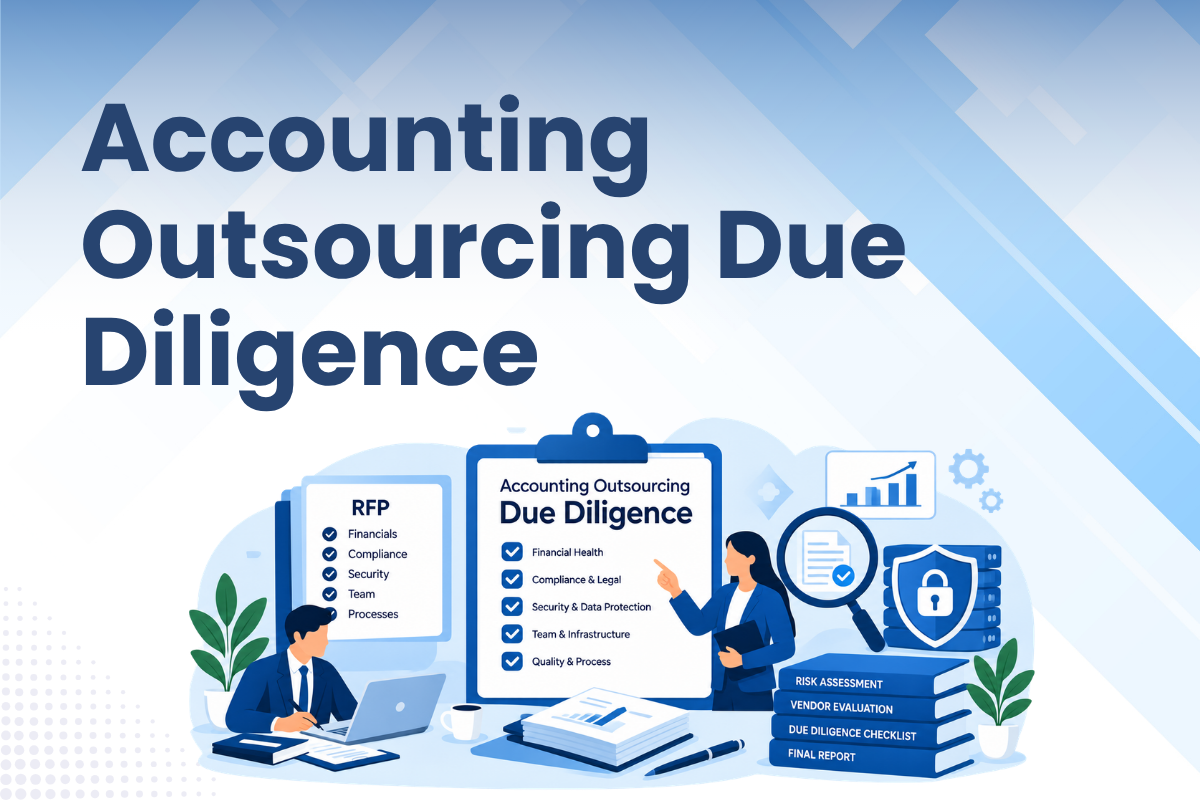
The 10-Point Accounting Outsourcing Due Diligence Checklist
The most effective CPA outsourcing checklist contains 10 points as follows:
1. Legal & regulatory compliance verification
First, make sure your contracts protect client information from every party that may access it. State your regulatory obligations explicitly rather than assuming the vendor already meets them, and review the vendor's privacy and security practices to confirm they fit your needs.
2. Financial stability & service continuity assessment
Ongoing accounting work needs a provider that can keep delivering well beyond the first engagement. Evaluate the provider's track record and its ability to supply the support staff and services you need, using a vendor financial stability check. Also consider business continuity, and ask how the provider plans to cover gaps in key staff availability during an emergency.
3. Infrastructure & technology evaluation
Software compatibility is essential. A provider should fit into your existing systems and workflows rather than forcing your firm to change its own processes.
TAG's preferred delivery model is fully embedded: the team works inside the client's own domain, email, time zone, and tools. A back-end arrangement is also available when required.

4. Data protection & client confidentiality (IRC 7216)
Before delegating work to a third party, consider which information you will need to share, including client contact information, tax IDs, and returns. Section 7216 limits how tax return preparers can use or disclose tax return information and, in some cases, requires taxpayer consent.
Before transferring tax data, verify which consent requirements apply to your workflow and the information involved, rather than relying on a general confidentiality clause.
5. Quality assurance & internal review process
A good quality assurance process shows who prepares the work, who reviews it, how errors are corrected, and how issues are escalated. A strong process reduces the review burden on the CPA firm over time rather than adding another layer of repetitive checking.
6. Workforce expertise, team structure & continuity
Don't judge a vendor's team only by the senior people in the sales process. Check who will actually do the work, how backup coverage works, how work is reviewed, and what accounting experience the team has.
TAG's model employs full-time employees across accounting, FP&A, and transaction advisory, coordinated internally, with SOPs supporting continuity if an individual is unavailable.
7. Client references & case studies
Client references help most when they match the engagement you are planning. Case studies should match the work you plan to hand over, including its complexity. A simple bookkeeping reference does not demonstrate a provider's capability to manage reporting, multi-entity close, or complex reconciliations.
8. SLA & contractual terms review
A clear SLA for accounting outsourcing turns expectations into defined tasks. Review scope, turnaround standards, quality standards, communication, escalation processes, data security, contract termination, and transition support.
Do not rely on vague commitments such as "high-quality work" or "fast turnaround." The contract should define specific expectations for your workflow. Seasonal and changing workload volume should also be defined where needed.
9. Security assessments & independent assurance
Security due diligence should examine a provider's actual controls, not just certification names. If a provider claims SOC 2, ISO 27001, or another form of independent certification, ask for current evidence. Review the SOC 2 report or ISO 27001 certificate directly rather than accepting the claim as proof.
TAG's documented security model is client-controlled. TAG works within the client's ecosystem or on client-provided locked-down machines, and AI tools are used with prior consent rather than automatically on sensitive information.
10. Insurance coverage verification
Check what insurance coverage the vendor carries and whether it matches the complexity of the work you plan to outsource. Depending on the services involved, firms may consider cyber coverage or errors and omissions coverage. No single coverage fits every deal, so let the scope of work, the type of information involved, and contractual limits guide what you ask for.
| Due Diligence Area | What the CPA Firm Should Verify |
|---|---|
| Legal & compliance | Applicable legal, privacy, tax-data, and contractual requirements |
| Financial stability | Ability to support recurring work and maintain continuity |
| Technology | Compatibility with existing accounting systems and workflows |
| Data protection | Access, confidentiality, storage, and sensitive-data handling |
| Quality assurance | Preparation, review, correction, and escalation processes |
| Workforce | Relevant experience, team structure, and backup coverage |
| References | Evidence from comparable accounting engagements |
| SLA & contract | Scope, responsibilities, turnaround, and transition terms |
| Security | Controls and independent evidence where available |
| Insurance | Relevant professional liability and cyber coverage |
Key Data Points to Prepare Before Evaluating Vendors
Before evaluating vendors, a firm should prepare these key data points:
Define processes to be outsourced: scope & workflows
A clear outsourcing scope allows every shortlisted provider to respond to the same requirements, which helps firms compare providers and select the right partner. Document the accounting processes you plan to outsource, including turnaround time, source information, special exceptions, software, agreed deliverables, and checkpoints.
Map data sensitivity: PII, bank data & tax IDs
Classify the information in the workflow before giving the vendor any access. For example, a team member processing reconciliations may not need the same permissions as one handling payroll or tax preparation. Determine what data is actually needed and limit access to the rest. Client data that requires consent, data protection, and legal compliance needs closer review.
Set success targets: accuracy, turnaround & first-pass yield
Define what success looks like before the work starts. Useful metrics include first-pass acceptance, reviewer revisions, turnaround time, open errors, and communication response time. Set targets based on your firm's own needs, not a universal industry standard.
How to Run the Due Diligence Process Step-by-Step
Once your scope and internal requirements are defined, work through these four steps.
Step 1: Shortlist vendors & request documentation
Ask providers for clear documentation of the key contract clauses and any certifications they claim. After comparing, shortlist the vendors that align with the tasks you actually need. The purpose is to evaluate evidence rather than accept it.
Step 2: Conduct reference calls & review case studies
Speak with references and ask how the provider handled comparable work, communication, and errors. Request case studies that match your needs, as they provide additional evidence of the provider's capacity and capability.
Step 3: Test the provider before moving live work
Documentation tells you about a provider's process and client reviews, but a controlled test shows how it works in reality. A pilot engagement for accounting outsourcing does not involve live client work.
TAG follows a low-risk approach. The prospect sends a project they have already completed, and TAG redoes it. The firm can then compare the result against its own work on quality, standards, communication, and formatting, without putting a live client at risk.
Step 4: Finalize SLA & contract terms
After the pilot, finalize the SLA and contract terms. The SLA and contract should document turnaround time, scope, responsibilities, security protocols, escalation methods, and termination terms. They should also protect the review process agreed during the pilot.
Common Mistakes CPA Firms Make During Due Diligence
Most due diligence mistakes in accounting outsourcing are:
Accepting verbal security assurances without documentation
A statement like "We take security seriously" is not enough. Ask who is authorized to access information, how emergencies are handled, which controls actually exist, and what documentation supports any certification or audit claims. Clarify any unverified security claim before sharing sensitive client information.
Skipping the test phase before full commitment
References and proposals are not proof that a provider will handle your files, templates, communication format, and exceptions as required. Run a pilot before final commitment, as it provides direct evidence of how the workflow and client relationship are handled.
Ignoring IRC 7216 consent requirements for tax data
A confidentiality agreement does not automatically satisfy IRC 7216 consent requirements. When a provider works with tax return information, especially if it is disclosed to preparers outside the United States, the firm should confirm whether Section 7216 and its regulations require taxpayer consent.
Why Your Accounting Outsourcing Partner Must Hold Up to Scrutiny
A provider claiming to completely relieve you of your responsibilities is not the right accounting outsourcing partner. A strong partner can clearly prove that its team, controls, processes, and delivery model work consistently within the firm's defined standards.
What a trustworthy accounting outsourcing partner looks like
A trusted partner can document its entire workflow. TAG is an already-built finance function, not a staffing model: the team coordinates under one point of contact and works as an execution layer beneath the client's judgment.
So for a firm, the ideal due diligence principle is to evaluate the function and operating process, not just the number of professionals a vendor can provide.
How to evaluate fit without putting live client work at stake
A provider must be able to prove that it can work to your required standards. TAG's pilot approach gives firms a direct way to do that: share a project you have already completed, TAG redoes it, and you compare the result on quality, standards, communication, and presentation. No live client has to become the test case.
Startup Financial Planning & Growth Insights
1
How Financial Modeling Helps Startups Grow Smarter
›
2
How FP&A Drives Better Financial Decisions
›
3
Accounting and Bookkeeping Services
›
4
How Corporate Finance Supports Sustainable Growth
›
5
What a Fractional CFO Really Does for Small Businesses
›
6
How Ratio Analysis Reveals Business Performance
›
7
How Variance Analysis Improves Financial Planning
›
Conclusion
Thorough due diligence replaces assumptions with evidence about a provider's team, controls, and reliability before any live client work moves over.
Ready to put TAG through the same scrutiny? Send TAG a project you've already completed. We'll redo it so you can compare the results before committing to anything.
Related Blogs



Common
Questions
Your Guide to Due Diligence...
It is a structured list of what to verify before hiring a provider, including quality processes, insurance coverage, service-level agreements, and data security policies.
No single certification is required for every firm. A CPA firm may ask for a current SOC 2 report, ISO 27001 certification, or other independent evidence from the provider, where available.
The time needed varies with the type of service, the type of data involved, the number of providers you evaluate, the documents to review, and whether you run a pilot before moving live client work.
It depends. Section 7216 and related IRS regulations determine whether consent is required, based on the work involved and the type of information shared. Confirm this with qualified tax counsel before transferring tax data.
A pilot is a test conducted to evaluate a provider's capacity and capability before expanding the relationship. It does not put live client work at risk. For example, TAG re-delivers a project the prospect has already completed so the firm can compare quality, communication, and presentation before making a final commitment.