
RPA in Finance: A Guide for CFOs and Controllers

Authored by
Varun
Date Released
11 June 2026
Handling several clients or performing repetitive finance work can quietly become the real capacity problem for a fractional CFO or a controller. Bank reconciliations, invoice processing, data entry, report preparation, and number transfers between systems are examples of time-consuming tasks that require very little senior financial judgment. This is where Robotic Process Automation (RPA) becomes helpful. TAG uses RPA to support you in performing repetitive, rule-based digital tasks that clients usually perform manually.
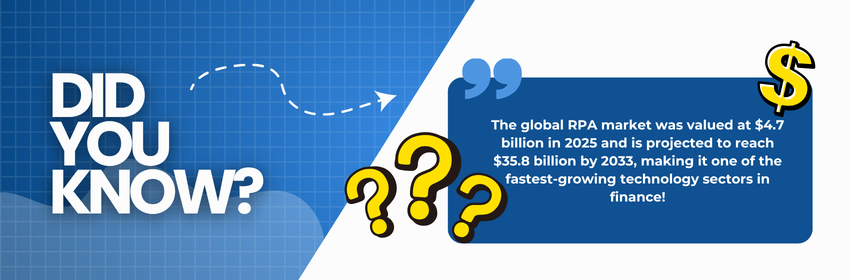
And adoption is continuing to grow. The global robotic process automation market was valued at about $4.7 billion in 2025 and is projected to reach $35.8 billion by 2033, according to Grand View Research.
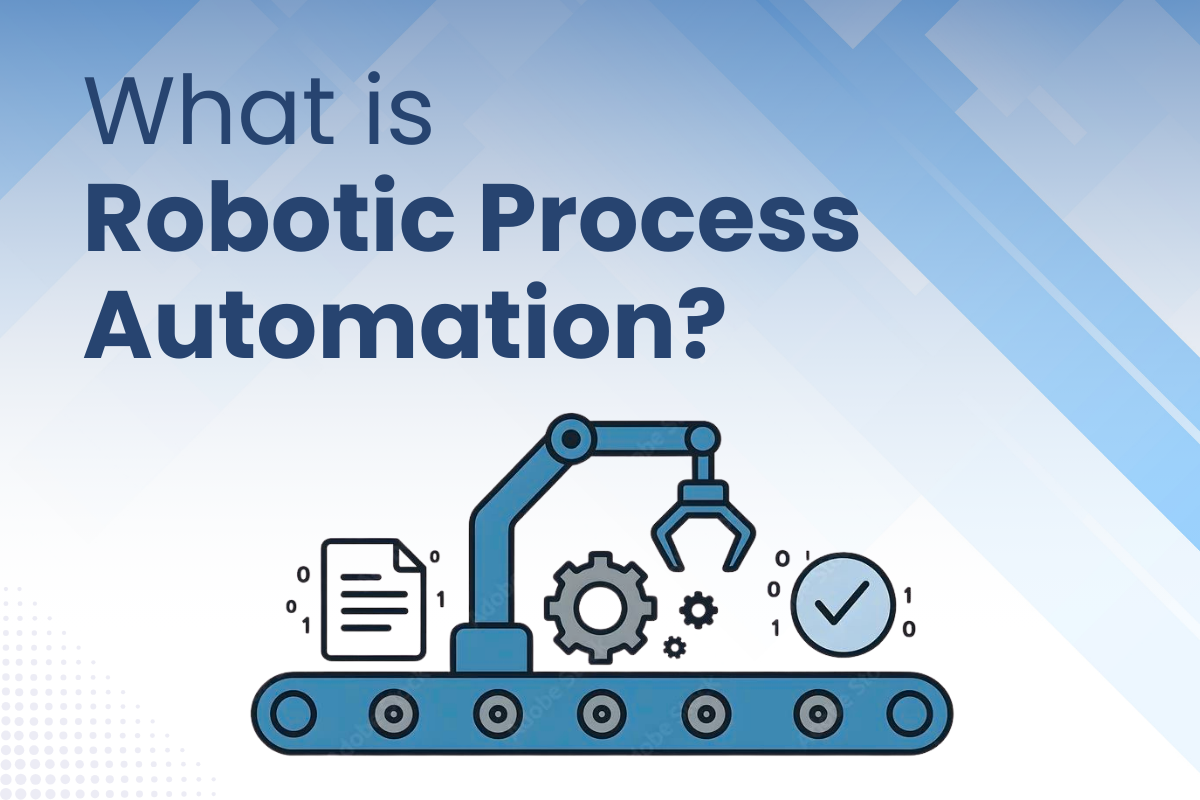
Table of Contents
What Is RPA in Finance Operations?
The simple answer to what RPA is: it is a robotic process automation software layer that follows predefined rules to perform routine computer-based tasks such as reconciliations, data transfers, and report preparation, and not forecasting judgment or client advice.
Let's understand through an example: if an accounting team receives transaction information from various sources each month, rather than repeatedly downloading files, transferring information into another system, renaming reports, and updating spreadsheets, an RPA bot will perform these steps according to a predefined workflow.
However, we acknowledge that a reconciliation process can be automated, but it demands a controller to decide why such material variance exists.
How Does Robotic Process Automation Work in Accounting?
A typical RPA automation workflow in finance functions in a straightforward sequence:
1. A Trigger Starts the Process
The automation process is started based on events such as the arrival of a new invoice, the conclusion of a reporting period, or the availability of a bank file.
2. The Robot Collects the Required Data
The robot software collects data from the specified source, which might include a spreadsheet, ERP, accounting application, company portal, or another business system.
3. Predefined Rules are Applied
The automated system follows instructions such as matching transaction IDs, checking fields, transferring values, or sorting records.
4. The Robot Completes the Routine Action
It allows you to enter information into another system, prepare a report, update a spreadsheet, or highlight transactions that do not meet the expected standards.
5. Exceptions Move to a Person
This is where basic data processing and finance functions diverge. The most beneficial workflow is frequently not to "let the robot decide" if the transaction does not follow the rules. Instead, it lets the robot find the exception and provide the controller with a clearer issue to examine.
Where Is RPA for Accounting Most Useful?
RPA for accounting is most effective in high-volume workflows where employees perform repetitive steps every day or every month.
Reconciliations
A robot pulls transactions from multiple systems, compares them with records according to predefined matching rules, and finds exceptions. Instead of manually checking every transaction, the accounting team can spend more time investigating the transactions that actually do not match. As a result, the controller's responsibilities shift from matching to reviewing exceptions.
Accounts Payable and Invoice Processing
Invoice processing often includes repetitive activities such as recording information, validating fields, matching records, and entering information into accounting systems. This is where automation performs its main role of handling large volumes of data. However, skilled accounting oversight is still important in case an invoice is duplicated, allocated to the incorrect account, or does not follow the typical approval pattern.
Bookkeeping and Data Entry
Whenever information moves repeatedly between structured systems, bookkeeping automation reduces the required amount of routine entry. Even a small reduction in repetitive entry across every account can create significant additional capacity for CPA firms managing multiple client books.
Reporting Preparation
Robots can collect routine information, update predefined reports, organize files, and move data into reporting workflows. The report still needs interpretation. A fractional CFO's role is not simply putting a KPI into a presentation; instead, it is explaining why it changed, how much it matters, and what the client should do next.
Here's how TAG applies the same approach to its own reporting workflows. Its white-label financial dashboard connects with systems such as QuickBooks, Xero, and NetSuite and brings live P&L, balance sheet, and cash flow information into one customized reporting configuration.
Rather than positioning the dashboard as a standalone automation product, TAG uses it as part of its accounting and FP&A delivery. In short, technology controls reporting flow while finance professionals remain responsible for the analysis and judgment around the numbers.
Automated Month-End Close
Month-end contains many structured and repetitive tasks, including data extraction, recurring reconciliations, report preparation, and standard validation checks. According to IBM benchmark research, companies that use optimized RPA in general accounting have a 25% faster month-end-close cycle.
That does not mean the entire close should run without people. It means automation can remove some of the repetitive steps so that controllers have more time for review, adjustments, and financial analysis.
How RPA Helps Fractional CFOs and Controllers Save Time
This is the point at which finance automation for CFOs becomes more interesting rather than reducing labor.
A fractional CFO may serve several clients simultaneously. Usually, the ability to copy numbers between spreadsheets is not their limited resource; rather, it is their time to understand those numbers, communicate with clients, and make decisions.
The same applies to an accounting-firm owner. Senior employees are unable to review results, counsel clients, or grow the practice because they spend every hour on repetitive backend work.
This highlights that RPA does not only create more hours in the day; rather, it minimizes the number of hours that go into repeatable execution.
Real TAG engagement: A US-based SaaS business was dealing with fragmented financial reporting and manual model updates while preparing for a Series A fundraise. TAG standardized its financial models and developed scalable automated KPI dashboards, while reducing the manual reporting effort and creating better visibility as the business expanded.
The automation supported the reporting process; the finance work around modeling, fundraising, and interpretation still required experienced finance officials.
Why Automation Still Needs a Human Review Layer in Bookkeeping
When RPA is presented simply as a software robot that works faster than humans, this point gets lost. Consider a controller using automation to process transactions.
Even if the robot correctly follows the rule it was given, what if the source information itself is wrong? Or if an unusual expense has been credited to the account the rule specifies, but the underlying treatment doesn't make financial sense?
In such scenarios, the accounting problem still exists. Hence, it's said that automation handles volume and financial professionals handle context.
TAG takes a similar stance on both automation and AI. Technology can speed up data structuring, reporting, and analytical work, but finance still needs someone who can ask significant, important questions. According to TAG, automation does not take the place of the human review layer; rather, it frees up resources for additional analysis, scenarios, and viewpoints.
We believe that clients are not paying only for faster numbers; rather, they are paying for trust in those numbers.
The Benefits of RPA Full Form Robotic Process Automation
1. More Capacity Without Adding Repetitive Work
When recurring processes can be automated, existing staff can absorb more volume without every additional client creating the same amount of administrative work. For a growing CPA or fractional CFO practice, that can make scale much more manageable.
2. Minimal Coding
Usually, to set up RPA, there is no need for a developer due to its drag-and-drop interface. Even employees with a nontechnical background can easily manage to create the automated workflow.
3. Faster Reconciliations and Close Support
Automating structured tasks can reduce the manual work surrounding reconciliations and reporting. For instance, RPA improves invoice processing, fastens month-end close, and saves time for FP&A and other strategic tasks performed by the finance team.
4. Extra Time for Work in Higher-Value Finance
High-performing finance organizations spend more time on value-added work rather than time-consuming tasks such as transaction processing, reinforcing the broader shift from finance execution toward finance insight. The reason is that advisors have more time for clients, controllers have more time for controls, and CFOs have more time for forecasts.
5. Improves Employee Confidence
With the proper implementation of RPA inside the organization, the heavy workload tasks get simplified, and this helps employees by freeing them from the burden of repetitive tasks and instead focusing on thoughtful and strategic decision-making tasks. This approach has led to great improvement in the working practices of employees.
6. Better Accuracy and Compliance
RPA robots are specifically designed to perform predefined workflows and practices; this reduces the chances of repetitive human error that requires precision and regulatory compliance practices. It is capable of creating an audit trail, which supports tracking progress and addressing issues.
The Real Limitations of RPA in Accounting
Automation does not turn bad processes into good ones. If the underlying workflow is inconsistent or poorly defined, automating it may simply allow the problem to move faster. Processes normally need to be standardized before they can be automated effectively.
TAG saw the importance of that foundation in a very different kind of finance engagement. A US subsidiary of a public company, roughly $50 million in size, lost its entire finance team in a single day. There was no proper knowledge transfer, vendors had unclear payment visibility, and the finance function first had to be rebuilt.
TAG reconstructed AR, AP, systems access, and operating processes, and within roughly four to five months, the company was running a clean five-day close.
Exceptions Still Need Judgment
A robot can follow predefined rules exceptionally well. Unusual transactions, changing accounting treatments, unclear documentation, and unexpected client situations do not always fit within those rules.
This is the reason the best RPA for accounting workflows usually automates the predictable work and pushes exceptions toward the right person instead of trying to remove them completely.
Accounting, Reporting & Outsourcing Insights You Shouldn’t Miss
1
How Financial Reporting Automation Actually Works
›
2
What Makes Financial Reporting Truly Consistent
›
3
Why Businesses Are Moving to Accounting Outsourcing
›
4
Why Bookkeeping Still Matters for Every Business
›
5
The Biggest Accounting Challenges SMEs Will Face
›
6
What Really Matters in Management Accounting
›
How to Implement RPA Full Form Effectively?
Implementation of RPA full form can be challenging, as older business processes are complex and often require careful handling to perform well. There are 7 tips to implement RPA effectively within your organization, as follows:
Step 1: Set and Manage Expectations
RPA delivers faster results, but setting it across the organization is more challenging. Many issues arise when expectations are not fulfilled properly.
So it is important to start with a question: where is our finance team losing repetitive hours every month? Maybe it is reconciliation, maybe it is invoice entry, or maybe it's moving information into reporting templates. Find the pain first.
Step 2: Consider Business Impact
Usually, RPA is used to boost the return on investment and cut costs, but it also improves the customer experience. For instance, the finance company that employs thousands of employees to get their clients' calls fielded is still waiting in queues. With the help of automation, these waiting periods for clients can be reduced.
Step 3: Standardize the Workflow
Document what happens today, who approves what, and what happens when an exception appears. Automating an undocumented process tends to create new problems.
Step 4: Define the Human Review Point
Don't treat human review as something added after the bot is built. Design it from the beginning. Decide which exceptions get flagged, who reviews them, and what requires approval before anything reaches the books or the client.
Step 5: Pilot Before Scaling
Test the automation on a controlled workflow first. Compare the automated output with the existing process, measure the time saved, and check whether new exceptions or control risks have appeared.
Step 6: Measure Finance Outcomes
Don't judge an RPA project by how many bots were deployed. Measure results a finance leader actually cares about: close time, reconciliation backlog, exception rates, reporting turnaround, and hours returned to senior staff.
Step 7: Expand Only Where It Adds Value
Once one workflow is reliable, move to the next bottleneck. The target should be better finance operations so that business processes will run faster, with higher efficiency, and at scale, not automation for automation's sake only.
Conclusion
Robotic process automation is most valuable in finance as it supports reconciliations, invoice processing, bookkeeping automation, recurring reporting, and an automated month-end close. But it cannot replace the judgment required to investigate an unusual balance, challenge a forecast, or explain financial performance to a client. This is also how TAG handles automation, with skilled finance professionals at the top and technology at the bottom.
Want to see how that could look inside your own workflow? Send us a reporting, reconciliation, or finance project you have already completed. Without endangering a current client, TAG can re-deliver the project so that you can compare the output, communication, and quality to your current workflow.
Related Blogs



Common
Questions
Your Guide to RPA...
The full form is Robotic Process Automation, and it makes use of software robots to complete routine, rule-based tasks that individuals would normally perform using digital systems.
No, it's not essential to have knowledge of coding; instead, the RPA tools rely on a user-friendly drag-and-drop setup, so a bookkeeper or controller does not depend on a developer to build a basic reconciliation or data-entry workflow.
RPA can automate specific repeatable activities within the close, including data collection, reconciliation support and recurring report preparation. It should normally complement rather than remove the controller's review of adjustments, exceptions and final financial results.
Finance automation for CFOs reduces the time spent on repetitive preparation and reporting. That allows fractional CFOs to devote more attention to forecasting, analysis, scenarios, client communication, and strategic decisions.
Usually, RPA services involve finding repeatable workflows, building automation, deploying bots, testing control systems, and maintaining automated processes. Rather than positioning itself as an RPA software provider, TAG offers a more comprehensive range of services, including reporting automation, accounting, finance execution, and FP&A.