
Startup Bootstrapped Financial Modeling: The Founder's Complete Guide

Authored by
Varun
Date Released
25 Jun, 2026
Setting a foundation for a startup without the support of outside funds demands more planning than just a great idea. Smart startup bootstrapped financial modeling helps startup founders by providing them with a clear overview of cash flow, expenses, runway, and profitability. In addition to this, it protects founders from small problems before they transform into costly ones by giving a clear picture of their sustainable growth. In this guide, you'll learn how to build a startup financial model, avoid startup budgeting financial modeling mistakes, track key metrics, and make better business decisions using facts.
What Is Startup Bootstrapped Financial Modeling?
Startup bootstrapped financial modeling is the process of forecasting a startup's finances using founder savings, early revenue, customer payments, and operating cash flow instead of outside investors' funding. In simple terms, it is a financial roadmap that helps founders use each and every dollar wisely so that the business can grow steadily without giving up ownership or putting cash flow under pressure.
Additionally, if you are confused about whether startup bootstrapped financial modeling is the same as bootstrapped financial modeling — the answer is yes, both are generally used to describe the same approach: revenue-first and self-funded.
How bootstrapped financial modeling differs from VC-backed models
Startup bootstrapped vs. VC-backed financial modeling comes down to different priorities. While one focuses on careful growth, the other is built for rapid expansion.
Table of Contents
Startup Bootstrapped vs. VC-Backed Financial Modeling
| Area | Bootstrapped Financial Modeling | VC-Backed Financial Modeling |
|---|---|---|
| Funding | Uses founder savings, customer revenue, and profits to keep the business running. | Relies mostly on investor funding to support growth. |
| Main goal | Focuses on steady growth, long-term stability, and reaching profitability sooner. | Prioritizes rapid expansion, even if profits come later. |
| Spending | Every expense is planned carefully while keeping costs lean. | Expenditure runs higher, with an approach to grab market opportunities first. |
| Focus | Frequently assesses cash flow, runway, and sustainable profits. | Concentrates more on growth rate, valuation, and market share. |
| Hiring | New team members are added only when revenue can support them. | Hiring often happens before revenue catches up. |
| Forecasting | Assumptions stay practical and a bit more cautious. | Forecasting is more focused on faster growth. |
| Risk | Relies on a lower-risk approach to protect company cash reserves. | Ready to trade growth potential for higher risk. |
| Break-even | Reaching break-even early is a key milestone. | Breaking even is often delayed while scaling. |
| Marketing | Budgets stay limited, with a strong focus on ROI. | Marketing spend is larger and more experimental. |
| Success | Consistent profits and sustainable growth define success. | Success is more influenced by valuation, scale, and investor returns. |
Why Revenue-First Modeling Matters for Bootstrapped Founders
5 Core Pillars of a Strong Startup Bootstrapped Financial Model
These five practical components of startup financial model planning help founders make smarter decisions, protect cash flow, and expand at a speed the business can actually afford.
Revenue assumptions built on real data, not optimism
Startup bootstrapped financial modeling works best when revenue forecasting estimates come from actual customer data, not hopeful guesses. For instance, if 12 customers spend $2.5K per month on a subscription plan, the forecast highlights $30K — no more — which ideally includes subscription charges, installation service, and one-time sales revenue for a more reliable overview.
Cost structure designed for flexibility
A healthy startup cost structure separates fixed costs like salaries and rent from variable costs such as marketing. In startup bootstrapped financial modeling, fixed spending should only increase after recurring revenue stays consistent for a few months.
Cash flow forecasting — the survival metric
Strong cash flow forecasting practices track every inflow and outflow. Keep enough cash to cover at least three to six months of expenses, because protecting your startup runway is what keeps the business moving.
Break-even analysis — the stability target
A break-even analysis shows the revenue needed to cover every expense.
Use the break-even revenue formula: Fixed Costs ÷ Gross Margin %.
Once you reach break-even, growth becomes much more sustainable.
Margin buffer strategy — financial shock protection
A margin buffer strategy gives your startup's financial planning room to breathe. Maintaining a 20–30% cash reserve aside helps mitigate unpredictable expenses and keeps the business stable during less favorable economic periods.
Key Components of a Startup Bootstrapped Financial Model
A three-statement model is the basic foundation of startup bootstrapped financial modeling. It combines a profit and loss statement, cash flow statement, and balance sheet — one of the most valuable components when making any type of strategic decision.
Profit & Loss (P&L): It's like a report card for your business. It shows how much money is coming in, how much is going out, and whether you're making a profit. This helps you figure out if your business is doing well.
Cash Flow Statement: It's like a diary that keeps track of all the money that comes into your business and all the money that goes out. It makes sure you have money to keep your business running every day.
Balance Sheet: It's like a snapshot of your business. It shows what you own, what you owe, and what is yours, giving you an idea of how healthy your business is.
Unit economics: CAC, LTV, ARPU & churn
CAC: Customer Acquisition Cost highlights what you spend to get one customer. A healthy CAC-to-LTV ratio starts here.
LTV: Lifetime Value calculates the money you get from a customer over time. Its value must be higher than CAC.
ARPU: Average Revenue Per User means how much money you get from each customer every month.
Churn: This is when customers cancel their subscriptions. You need to keep an eye on this so you can try to keep your customers happy and stop them from leaving — because in unit economics, a small rise in churn can significantly drop profits, leading to slow growth.
Burn rate and runway calculation
The burn rate formula tells you the amount of cash your startup is losing every month after revenue comes in.
Step 1: Add up your monthly cash outflow. Let's say it's $15,000.
Step 2: Subtract it from your monthly cash inflow of $9,000. So, $15,000 − $9,000 = $6,000.
Step 3: Consider a firm that has $50K in the bank. Divide the cash in the bank by the net burn rate: $50,000 ÷ $6,000 = your startup has 8 months and 3 weeks of runway.
Those 8 months and 3 weeks are not fixed — the runway will stretch if revenue grows or expenses come down. Keeping an eye on both numbers every month helps you spot challenges before cash becomes a real issue.
Scenario assumptions & KPI dashboard
A strong startup financial model keeps track of key metrics founders rely on while testing realistic, best-case, and worst-case scenarios. If sales fall or costs suddenly rise, you'll already have a clearer plan of action rather than panicking.
How to Build a Startup Bootstrapped Financial Model (Step-by-Step)
Here is a practical framework founders can use to build a startup bootstrapped financial model.
Step 1-2: Define business model & list revenue streams
Start by defining exactly how the business earns money. After you define revenue model assumptions, separate revenue-generating elements such as subscriptions, products, services, commissions, or one-time fees instead of combining them all together. These elements clearly define your revenue sources.
In short, this also defines CAC (cost to acquire one customer), CAC payback (time required to recover the acquisition expense), LTV (customer's total value over a period), ARPU (average revenue per user), churn (percentage of customer cancellation), and gross margin (revenue left after direct expenses), as these terms define company performance more systematically.
Step 3-4: Estimate customer acquisition & forecast costs
After listing revenue-generating sources, calculate new customer acquisition numbers using practical inputs like website traffic, conversion rates, organic search growth, word of mouth, additional sales, and advertising expenditure. Then map your startup's cost structure, separating fixed from variable costs so future spending stays manageable.
Step 5-6: Build cash flow forecast & calculate burn rate
Create a monthly cash flow forecasting sheet to track every dollar coming in and going out. Then apply the burn rate formula to understand how quickly cash is being used and how long your runway will last.
Step 7-8: Calculate break-even & add scenario planning
Run a break-even analysis to determine the minimum revenue required to cover expenses. Then forecast scenarios for at least four months, including initial funds, closing funds, cash inflow, and cash outflow. Because startups run on uncertainty, scenario planning helps founders stay ready for challenges before they occur.
Step 9: Review actuals every month
A model only works if it stays current. As part of startup bootstrapped financial modeling, compare actual revenue, costs, cash flow, CAC, and churn with projections every month. For sustainable growth, a startup founder must review the model every month.
Bottom-Up vs Top-Down Forecasting: Which Is Right for You?
What is bottom-up forecasting for startups?
Bottom-up forecasting calculates future revenue by analyzing the smallest business driver information — like customers, products, pricing, or sales volume — and then shifting upward to revenue. Instead of depending on general market assumptions, it concentrates on actual business data and business-specific drivers. This makes revenue forecasts more practical, realistic, and easier to adjust as the startup expands.
What is top-down forecasting & when to use it?
Top-down forecasting starts by analyzing market size, economic conditions, industry trends, and total demand instead of focusing directly on a company's projected revenue. In a bootstrapped approach, it works well when historical business data is limited, or you're estimating market potential. It gives a realistic starting point, though it should ideally be supported with bottom-up estimates for better accuracy.
Bottom-up vs. top-down forecasting
When comparing bottom-up vs top-down forecasting, the right option depends on your available information and the startup's stage. Top-down forecasting looks at market size, industry trends, and the market share you expect to capture — it's more about the big picture. Bottom-up forecasting, on the other hand, starts with your customers, pricing, and sales capacity. For founders bootstrapping financial modeling for the first time, a bottom-up approach is usually easier, since it focuses on real business numbers, making forecasts more realistic and simpler to update.
Startup Bootstrapped Financial Modeling Formulas Every Founder Must Know
Getting familiar with a few core formulas can make planning much easier. In startup bootstrapped financial modeling, these numbers help founders track cash, measure growth, and avoid running out of money too soon.
Runway formula: how long can your startup survive?
To calculate startup runway, divide your available cash by your monthly burn rate. This simple formula tells you how many months your startup can keep operating before funds run out, giving you time to adjust spending and raise revenue.
Runway = Current Cash Balance ÷ Monthly Burn Rate
Burn rate formula: track your monthly cash outflow
The burn rate formula measures how much cash your business spends every month. To calculate startup burn rate, subtract monthly revenue from monthly operating expenses. Tracking this regularly helps you control costs before they quietly become a bigger problem.
Burn Rate = Fixed Costs + Variable Costs
Break-even revenue formula
The break-even revenue formula helps you find the sales required to cover all business expenses without making a profit or a loss. With a proper break-even analysis, founders can set realistic revenue goals and determine when the company will become financially sustainable.
Break-Even Revenue = Total Fixed Costs ÷ Gross Margin %
LTV, CAC & CAC payback period formulas
Strong unit economics depend on tools such as Customer Lifetime Value (LTV), Customer Acquisition Cost (CAC), and the CAC payback period. The LTV formula calculates how much value a customer brings over time; comparing it with CAC confirms whether your customer acquisition strategy is actually profitable in the long run.
LTV = ARPU × Gross Margin % ÷ Churn Rate
CAC = Total Marketing & Sales Spend ÷ New Customers Acquired
CAC Payback Period = CAC ÷ Monthly Gross Profit Per Customer
Startup Financial Planning & Growth Insights
1
How Financial Modeling Helps Startups Grow Smarter
›
2
How FP&A Drives Better Financial Decisions
›
3
Why Capital Budgeting Matters for Growing Businesses
›
4
How Corporate Finance Supports Sustainable Growth
›
5
What a Fractional CFO Really Does for Small Businesses
›
6
How Ratio Analysis Reveals Business Performance
›
7
How Variance Analysis Improves Financial Planning
›
Common Mistakes in Startup Bootstrapped Financial Modeling
Mistake 1: Overly optimistic revenue assumptions
In startup bootstrapped financial modeling, founders often make revenue assumptions that are overly optimistic. It's easy to expect rapid growth, but actual results depend on lead generation, conversion, customer acceptance, and churn. To keep the financial model practical and credible, startups must forecast using facts, not assumptions or market-size dreams.
Mistake 2: Ignoring cash flow timing
The most common mistake in cash flow forecasting is assuming revenue and cash will arrive at the same time. They rarely do. Customers may take two to three weeks, or even months, to pay, while expenses such as payroll and rent are paid immediately. So even with a strong sales team, your startup might suffer a cash crisis. Always forecast when money actually enters your account, not just when revenue is recorded.
Mistake 3: Copying a VC-backed financial model
In startup bootstrapped vs VC-backed financial modeling, one model doesn't fit every business. VC-backed startups usually concentrate on quick growth by delaying profits, supported by investor funds. Bootstrapped startups demand stable revenue, careful cash management, and early profitability, making financial discipline a far more important factor from day one.
Mistake 4: Not separating fixed and variable costs
A clear startup cost structure separates fixed and variable expenses. Fixed costs stay the same, while variable costs rise with revenue. Understanding fixed vs variable costs helps founders stay flexible and avoid locking into high expenses before steady income arrives.
Mistake 5: Not updating the model regularly
If you're wondering how often founders should update the financial model, the answer is simple: regularly. It's not a one-time file — it's a routine document that should evolve with the business. Check it twice a month, or weekly if cash flow is tight, and compare forecasts with actual outcomes.
Best Tools & Templates for Startup Bootstrapped Financial Modeling
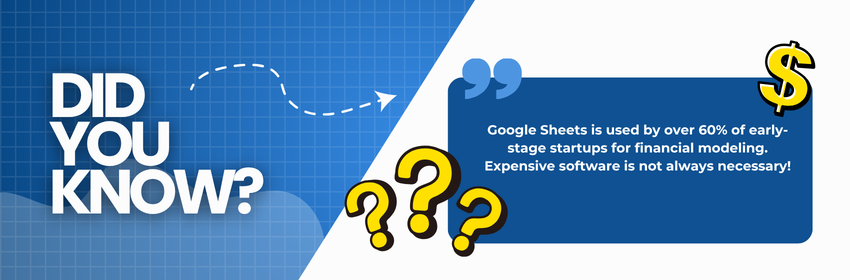
When you're just starting out, expensive financial software usually isn't necessary. A bootstrapped startup can rely on simple spreadsheet software — even Google Sheets or Excel can handle most of your planning if it's updated regularly. Pair it with an appropriate accounting tool like Xero or QuickBooks for a solid setup without stretching your budget. Keep your model practical and easy to update. Consider the following three scenarios.
Best Case: The best-case scenario shows what happens if the business performs better than expected. Revenue goes up, expenses stay under control, and the company starts generating positive cash flow rather than just surviving.
Base Case: The base-case scenario assumes the business performs at the expected level, reaching break-even by maintaining steady revenue growth and predictable expenses.
Worst Case: The worst-case scenario prepares you for difficult situations where sales fall below expectations while expenses stay the same or increase, reducing cash reserves and narrowing the runway.
Google Sheets vs Excel: which is better for founders?
Yes, a bootstrapped startup can use simple spreadsheet tools. A startup financial model template in Google Sheets is usually enough early on, since it's free and easy to share. Excel becomes a better choice later, once your financial model gets more detailed and complex.
Conclusion
Startup bootstrapped financial modeling is not about creating spreadsheets; it's about making confident decisions before any cash crisis lands. When a startup has a clear overview of its cash flow, costs, and growth, it's far more likely to build a stable, growing business rather than just survive. Keep your financial model realistic, update and review it often, and let it guide your next move. Struggling with setting up the right financial model that fits your startup? Book a consultation today and get expert guidance to plan with facts, not assumptions.
Related Blogs



Common
Questions
Your Guide to Bootstrapped Financial Modeling...
Startup bootstrapped financial modeling is a step-by-step process of calculating a startup's revenue, expenses, cash outflow and inflow, runway, burn rate, and profitability with appropriate forecasting. It relies on internal revenue rather than outside funding.
Yes — startup bootstrapped financial modeling concentrates on revenue-first growth and cash control rather than depending on VC funding.
A startup bootstrapped financial model should ideally track expenses, revenue, burn rate, gross margin, cash flow, runway, CAC, LTV, ARPU, churn, profit margin, and break-even revenue.
A bootstrapped startup must maintain a balance between growth and profit. Growth matters for every startup, but if it creates too much pressure on cash flow, steady growth is more effective than rapid growth.
A startup bootstrapped financial model should be updated weekly when cash flow is tight and the startup has less than six months of runway; otherwise, it should be reviewed monthly.